
Rubber snow plough blades
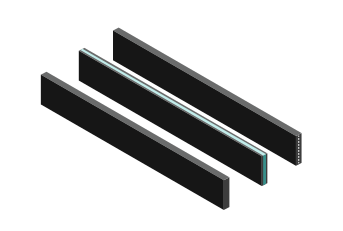
Rubber snow plough blades are strips with or without a textile or steel insert, made of an SBR/NR rubber compound with very good wear resistance, even in harsh operating conditions, at temperatures from -30 to +70 °C.
The rubber compound is also not attacked by the sodium chloride (NaCl) solution used to de-ice roads.
All these scrapers give excellent results cleaning conveyor belts that carry very wet material, cleaning smooth surfaces with typical machinery (platforms, asphalt roads) and removing snow from asphalt roads.
Guide price: from approx. 150 lei/piece + VAT
The exact price depends on size, quantity and make-up; we send it in our quote.
Fields of application
 Mining and quarrying
 Building materials
 Production lines
 Waste recycling
 Automotive industry
Types of snow plough blades
They come in several constructions:
- rubber only: very flexible, they follow the shape of the scraped surface and clean it thoroughly.
- with textile insert: stiffer, but with a low friction coefficient, so they last longer. Because of their stiffness they cannot follow every hollow in the surface.
- with steel insert: less stiff and more durable than blades with a textile insert, but the steel insert (cable) scratches the surface it touches.
Blade dimensions
| Type | Width (mm) | Thickness (mm) | Length (mm) |
|---|---|---|---|
| With textile insert | 250 | 40 or 50 | 500; 750; 800; 900; 910; 1000; 1060; 1210; 1500; 1600; 1800; 2000; 2400; 2500; 3000 |
| With steel insert | 200 | 40 | 500; 600; 800; 900; 1000; 1200; 1500; 2000; 2500; 3000 |
| With steel insert | 200 | 50 | 500; 600; 800; 900; 1000; 1200; 1500; 2000 |
| Rubber only | on request | on request | on request |
Tolerances: length ±3%, thickness ±1.6 mm, width ±1.5%.
Physical and mechanical properties of the rubber
| Property | Rubber-only blades | Blades with textile insert | Blades with steel insert |
|---|---|---|---|
| Tensile strength (kgf/cm2, min.) | 100 | 100 | 100 |
| Elongation at break (%, min.) | 200 | 150 | 200 |
| Hardness (°Shore A) | 50-75 | 70-85 | 65±5 |
| Abrasion loss (max., mm3) | 250 | – | 150 |
| Accelerated ageing resistance (168 h × 70 °C) a) loss of tensile strength (%, max.) b) loss of elongation (%, max.) c) increase in hardness (Shore A, max.) |
30 30 +10 |
– | 30 50 15 |
| Low-temperature resistance (°C) | – | – | -40 |
| Cord–rubber adhesion (kgf/cm, min.) | – | – | 100 |
| PES/PA textile insert content (%, min.) | – | 70 | – |
Frequently asked questions
Which types of snow plough blades are there?
All-rubber blades, very flexible, which follow the surface; textile-reinforced blades, stiffer and longer-lasting; and steel-cable reinforced blades, the strongest, but they can scratch the surface being cleared.
Do they resist road salt?
Yes. The rubber compound is not attacked by the sodium chloride (NaCl) solution used to de-ice roads.
What temperatures can they work at?
From -30 °C to +70 °C. The SBR/NR compound has very good wear resistance, even in harsh conditions. Blades with a steel insert are rated down to -40 °C.
What sizes are the blades?
Blades with a textile insert are 250 mm wide, 40 or 50 mm thick and 500 to 3000 mm long. Blades with a steel insert are 200 mm wide and 40 mm thick (500 – 3000 mm long) or 50 mm thick (500 – 2000 mm long). The datasheets on this page give the details.