
General purpose steel cord conveyor belts
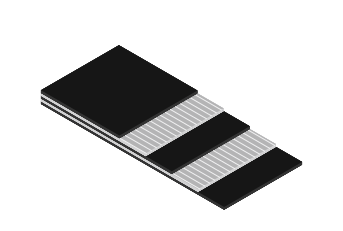
General purpose steel cord rubber conveyor belts carry loose bulk materials on high-capacity conveyors over long distances and in difficult conditions. They are used on many kinds of conveying lines, for example in mining, metallurgy, ports and building materials, for lumps, large pieces and powders.
The carcass of a steel cord conveyor belt is made of very high-strength steel cords lying in one plane.
Fields of application
 Mining and quarrying
 Chemical industry
Cover properties
- Abrasion resistance
- Cut resistance
- Tear resistance
- Antistatic
| Technical characteristics | DIN | RR (N/mm) | AR min., (%) | Abrasion max. (mm3) |
|---|---|---|---|---|
| Rubber covers with high abrasion resistance. | w | 180 | 400 | 90 |
| Rubber covers with high abrasion resistance. | x | 250 | 450 | 120 |
| General purpose belts with good resistance to abrasion and cuts. | y | 200 | 400 | 150 |
| Belts with flame-resistant covers. | k | 200 | 400 | 200 |
| Strength class | ST 800 | ST 1000 | ST 1250 | ST 1600 | ST 2000 | ST 2500 | ST 3150 | ST 4000 |
|---|---|---|---|---|---|---|---|---|
| Belt breaking strength, N/mm, min. | 800 | 1000 | 1250 | 1600 | 2000 | 2500 | 3150 | 4000 |
| Cord diameter, mm | 3,85 ±0,2 | 3,85 ±0,2 | 4,5 ±0,2 | 5,85 ±0,2 | 5,85 ±0,2 | 7,0 ±0,2 | 8,0 ±0,2 | 9,0 ±0,2 |
| Pitch, mm | 15 ±1.5 | 12 ±1.5 | 14 ±1.5 | 15 ±1.5 | 12 ±1.5 | 15 ±1.5 | 15 ±1.5 | 15 ±1.5 |
| Cover thickness, mm, min.*) | 4 | 4 | 4 | 4 | 4 | 5 | 5.5 | 6.5 |
| Belt thickness | On request | On request | On request | On request | On request | On request | On request | On request |
| Length (m) | On request | On request | On request | On request | On request | On request | On request | On request |
| Edges (mm) | 15 | 15 | 15 | 15 | 15 | 15 | 15 | 15 |
| Cord breaking strength, kN, min. | 13.2 | 13.2 | 19.2 | 26.4 | 26.4 | 41.2 | 52.0 | 66.0 |
| Rubber/cord adhesion, N/mm, min. | 70 | 70 | 85 | 85 | 85 | 100 | 110 | 120 |
Conveying incline
The top cover of a conveyor belt can be smooth or profiled, depending on the material conveyed and the incline of the conveyor.
- Smooth or patterned belts0–30°
Smooth belts are used for all kinds of processed or bulk material conveyed at an incline of up to 18–20°.
For inclines between 20 and 30°, patterned belts are recommended.
- Sidewall and cleated belts65–80°
These belts can have cleats only (no sidewalls) or cleats and sidewalls, which stop the material falling off the sides of the belt. They carry processed or bulk material while increasing the volume conveyed.
- Bucket belts90°
A special type of belt, made by bolting metal or plastic buckets onto a smooth belt. Bucket belts are recommended for process lines with narrow working space and operations on several levels.

Available splice types
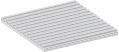
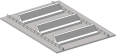
- Finger splice (zig-zag)
Meets every requirement for keeping an even thickness. A very flexible joint, needed especially on cleated belts. Recommended for belts with 1 or 2 plies.
- Stepped finger splice
Similar to the finger (zig-zag) splice and also suitable for heavy-duty operation. Recommended for belts with 2 or 3 plies.
- Bias (wedge) splice
A quick and simple splice for belts with many fabric plies.
- Step splice
Recommended for all textile ply belts with at least two plies.
Edge types
- Sealed (covered) edges
Recommended for belts thicker than 10 mm and for very humid or strongly corrosive environments.
Frequently asked questions
When should I choose a steel cord belt instead of a textile one?
For high-capacity conveyors over long distances and in difficult conditions, for example in mining, metallurgy, ports and building materials. The steel cord carcass has a very high breaking strength.
Which strength classes are available?
From ST 800 to ST 4000, where the number is the belt’s breaking strength in N/mm. The values for each class are in the specifications table.
Which cover grades can I choose?
W or X (DIN) covers with high abrasion resistance; Y, general purpose, with good resistance to abrasion and cuts; or K, flame-resistant.