
Steel breaker conveyor belts
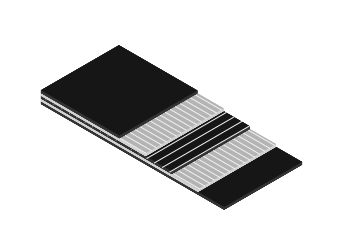
Rubber conveyor belts with a steel breaker are designed to withstand impact from sharp, bulky materials. They are also known as impact- and rip-resistant conveyor belts.
Their special properties come from the steel breaker ply, which helps the carcass and the whole belt resist ripping.
The carcass is made of polyamide/polyester (EP) or polyester/polyester (EE). The position of the breakers is chosen for each application.
Fields of application
 Mining and quarrying
 Chemical industry
Characteristics and dimensions
- Abrasion resistance
- Cut resistance
- Tear resistance
- Antistatic
| Size | Values |
|---|---|
| Width, mm | 800 - 1600 ± 1% |
| Thickness, mm | 8 - 24 |
| Cover thickness, mm | On request. |
| Belt thickness tolerance (over 10 mm) | ± 10 % |
| Cover thickness tolerance (over 4 mm) | -5% / + free |
| Length (m) | On request. |
| Ply type | EP 60 | EP 100 | EP 125 | EP 160 | EP 200 | EP 250 | EP 315 | EP 400 |
|---|---|---|---|---|---|---|---|---|
| Longitudinal breaking strength | 500 | 700 | 800 | 1000 | 1200 | 1500 | 2000 | 2200 |
| Transverse breaking strength | 250 | 250 | 350 | 380 | 500 | 500 | 500 | 500 |
| Breaker type | BF 125 RE | BF 125 HE |
|---|---|---|
| Transverse strength, N/mm | 125 | 125 |
| Weight, kg/m2 | 0.55 | 0.75 |
| Ply thickness, mm | 1.60 | 1.95 |
| Warp yarns | Nylon 940 × 2 × 2, RFL | Nylon 940 × 2 × 2, RFL |
| Density, yarns/m | 200 | 200 |
| Warp strength, N/mm | 50 | 50 |
| Weft yarns | 2 * 2 * 0.38 | 4 * 4 * 0.22 |
| Breaking load (average, N) | 1050 | 1220 |
| Brass coating % Cu | 63.5 | 63.5 |
| Brass coating % Zn | 36.5 | 36.5 |
| Pitch, mm | 7.5 | 8.9 |
| Density, cords/m | 133 | 112 |
| Ply-to-ply adhesion (kgf/cm, min.) | 5 | 5 |
| Ply-to-cover adhesion (kgf/cm, min.) | 3.5 | 3.5 |
| Ply-to-cover adhesion (kgf/cm, min.) | 4.5 | 4.5 |
Conveying incline
The top cover of a conveyor belt can be smooth or profiled, depending on the material conveyed and the incline of the conveyor.
- Smooth or patterned belts0–30°
Smooth belts are used for all kinds of processed or bulk material conveyed at an incline of up to 18–20°.
For inclines between 20 and 30°, patterned belts are recommended.
- Chevron belts30–65°
The rubber cleats moulded on the belt surface prevent or reduce slipping and increase the amount conveyed. Suitable for processed or bulk material that does not stick to rubber.
- Sidewall and cleated belts65–80°
These belts can have cleats only (no sidewalls) or cleats and sidewalls, which stop the material falling off the sides of the belt. They carry processed or bulk material while increasing the volume conveyed.
- Bucket belts90°
A special type of belt, made by bolting metal or plastic buckets onto a smooth belt. Bucket belts are recommended for process lines with narrow working space and operations on several levels.


Available splice types
- Finger splice (zig-zag)
Meets every requirement for keeping an even thickness. A very flexible joint, needed especially on cleated belts. Recommended for belts with 1 or 2 plies.
- Stepped finger splice
Similar to the finger (zig-zag) splice and also suitable for heavy-duty operation. Recommended for belts with 2 or 3 plies.
- Bias (wedge) splice
A quick and simple splice for belts with many fabric plies.
- Step splice
Recommended for all textile ply belts with at least two plies.
Edge types
- Sealed (covered) edges
Recommended for belts thicker than 10 mm and for very humid or strongly corrosive environments.
- Cut edges
Recommended for thin belts of up to 10 mm and for dry or low-humidity environments.
Frequently asked questions
When do I need a belt with a steel breaker?
When conveying sharp, bulky materials that could puncture or rip the belt. That is why they are also called impact- and rip-resistant belts.
Which sizes can you make?
Widths of 800–1600 mm and thicknesses of 8–24 mm. The length and the cover thickness are made to order.
What is the carcass made of?
EP (polyamide/polyester) or EE (polyester/polyester) plies, from EP 60 to EP 400. The breaker position is chosen to suit the application.