
Oil-resistant textile ply conveyor belts
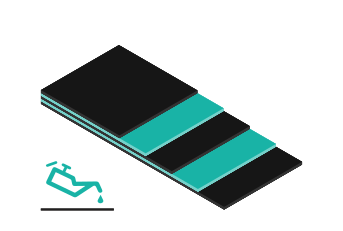
These textile ply rubber conveyor belts are recommended when the conveyed material contains mineral or vegetable oils or fats. Fats make the rubber of a general purpose belt swell, which degrades its physical and mechanical properties until it becomes brittle and unusable. ELASTIMPEX offers a wide range of oil-resistant textile ply belts to match the fat content of the material conveyed.
Fields of application
 Chemical industry
 Oil and gas industry
 Waste recycling
 Agriculture
General characteristics
- Available constructions: 250/2; 315/2; 400/3; 500/3; 500/4; 630/4; 800/4; 1000/4; 1250/5; 2000/6 (the first value is the belt breaking strength in N/mm, the second the number of plies);
- Standard widths go up to 2000 mm; other widths are made on request;
- Belt thickness from 4 to 30 mm;
- Standard lengths from 10 to 300 m;
- Elongation at reference load: 1–1.4%;
- Longitudinal elongation at break: 14–18%;
- The belt does not degrade in contact with fats or mineral or vegetable oils.
Cover properties
- Abrasion resistance
- Oil and fat resistance
- Tear resistance
- Antistatic
When choosing an oil-resistant belt, consider the material conveyed, the type of oil or fat it contains, its concentration and the temperature of the material during conveying.
| Type | Fields of application | RR (N/mm) | AR (%) | u (mm3) | dV* (%) | Operating temp. |
|---|---|---|---|---|---|---|
| MOR | Applications with a low concentration of vegetable fats and oils | 150 | 450 | 160 | +30 | -25°...+80° |
| G | Very good resistance to higher concentrations of fats and oils | 150 | 450 | 160 | +30 | -25°...+80° |
| ROS | Excellent resistance to vegetable, animal or synthetic oils and fats in high and very high concentrations | 160 | 300 | 125 | +6 | -25°...+120° |
* dV: change in volume after immersion in oil (70 h, 100 °C)
Conveying incline
The top cover of a conveyor belt can be smooth or profiled, depending on the material conveyed and the incline of the conveyor.
- Smooth or patterned belts0–30°
Smooth belts are used for all kinds of processed or bulk material conveyed at an incline of up to 18–20°.
For inclines between 20 and 30°, patterned belts are recommended.
- Chevron belts30–65°
The rubber cleats moulded on the belt surface prevent or reduce slipping and increase the amount conveyed. Suitable for processed or bulk material that does not stick to rubber.
- Sidewall and cleated belts65–80°
These belts can have cleats only (no sidewalls) or cleats and sidewalls, which stop the material falling off the sides of the belt. They carry processed or bulk material while increasing the volume conveyed.
- Bucket belts90°
A special type of belt, made by bolting metal or plastic buckets onto a smooth belt. Bucket belts are recommended for process lines with narrow working space and operations on several levels.


Available splice types
- Finger splice (zig-zag)
Meets every requirement for keeping an even thickness. A very flexible joint, needed especially on cleated belts. Recommended for belts with 1 or 2 plies.
- Stepped finger splice
Similar to the finger (zig-zag) splice and also suitable for heavy-duty operation. Recommended for belts with 2 or 3 plies.
- Bias (wedge) splice
A quick and simple splice for belts with many fabric plies.
- Step splice
Recommended for all textile ply belts with at least two plies.
Edge types
- Sealed (covered) edges
Recommended for belts thicker than 10 mm and for very humid or strongly corrosive environments.
- Cut edges
Recommended for thin belts of up to 10 mm and for dry or low-humidity environments.
Frequently asked questions
Which oil-resistant grades are there?
MOR, for low concentrations of vegetable fats and oils; G, for higher concentrations; and ROS, with excellent resistance to vegetable, animal or synthetic oils and fats in high and very high concentrations.
What should I include in a quote request?
The type of material conveyed, the type of oil or fat, its concentration and the material’s temperature during transport.
What temperatures can they work at?
MOR and G work from -25 to +80 °C, and ROS from -25 to +120 °C.