
Flame-resistant conveyor belts
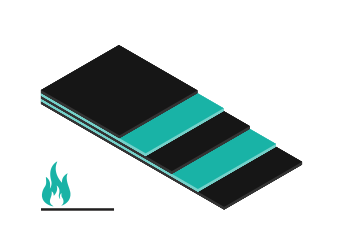
Rubber conveyor belts with a special construction that resists flame and prevents static build-up from friction (antistatic), which could otherwise cause explosions.
This type of rubber conveyor belt is also widely used for materials with a high content of vegetable, animal or inorganic fats and oils.
Guide price: from approx. 450 lei/m² + VAT
The exact price depends on size, quantity and make-up; we send it in our quote.
Fields of application
 Mining and quarrying
 Chemical industry
 Oil and gas industry
 Agriculture
 Waste recycling
General characteristics
- Increased resistance to open fire;
- The antistatic covers rule out the risk of explosions;
- The rubber covers have increased abrasion resistance.
Cover properties
- Antistatic
- Flame resistance
- Abrasion resistance
The covers of the belt can be flame resistant and antistatic only, or flame, explosion and oil resistant at the same time.
| Belt type | Application | RR(N/mm) | AR(%) | u (mm3) |
|---|---|---|---|---|
| GM+K | Medium oil resistance, antistatic and flame-resistant covers. Operating temp.: -25…70 °C | 140 | 350 | 200 |
| K | Flame resistant. Operating temp.: -25…70 °C | 150 | 350 | 200 |
| GM+S | Medium oil resistance, flame resistant and antistatic | 140 | 350 | 200 |
| G+K | Good oil resistance, antistatic and flame resistant. Operating temp.: -25…70 °C | 140 | 350 | 200 |
| G+S | Good oil resistance, antistatic and flame resistant | 140 | 350 | 200 |
| ROS+K | Excellent oil resistance with antistatic, flame-resistant covers. Operating temp.: -20…120 °C | 150 | 350 | 200 |
| ROS+S | Excellent oil resistance with flame-resistant, antistatic covers. | 150 | 350 | 200 |
Conveying incline
The top cover of a conveyor belt can be smooth or profiled, depending on the material conveyed and the incline of the conveyor.
- Smooth or patterned belts0–30°
Smooth belts are used for all kinds of processed or bulk material conveyed at an incline of up to 18–20°.
For inclines between 20 and 30°, patterned belts are recommended.
- Chevron belts30–65°
The rubber cleats moulded on the belt surface prevent or reduce slipping and increase the amount conveyed. Suitable for processed or bulk material that does not stick to rubber.
- Sidewall and cleated belts65–80°
These belts can have cleats only (no sidewalls) or cleats and sidewalls, which stop the material falling off the sides of the belt. They carry processed or bulk material while increasing the volume conveyed.
- Bucket belts90°
A special type of belt, made by bolting metal or plastic buckets onto a smooth belt. Bucket belts are recommended for process lines with narrow working space and operations on several levels.



Available splice types
- Finger splice (zig-zag)
Meets every requirement for keeping an even thickness. A very flexible joint, needed especially on cleated belts. Recommended for belts with 1 or 2 plies.
- Stepped finger splice
Similar to the finger (zig-zag) splice and also suitable for heavy-duty operation. Recommended for belts with 2 or 3 plies.
- Bias (wedge) splice
A quick and simple splice for belts with many fabric plies.
- Step splice
Recommended for all textile ply belts with at least two plies.
Edge types
- Sealed (covered) edges
Recommended for belts thicker than 10 mm and for very humid or strongly corrosive environments.
- Cut edges
Recommended for thin belts of up to 10 mm and for dry or low-humidity environments.
Frequently asked questions
What does antistatic mean for a conveyor belt?
The rubber covers do not let electric charges build up through friction, which could cause explosions. The belt also has increased resistance to open flame and to abrasion.
Which flame-resistant grades do you offer?
K (flame-resistant) and grades that combine flame resistance and antistatic properties with oil resistance: GM+K and GM+S (medium oil resistance), G+K (good) and ROS+K or ROS+S (excellent oil resistance).
What temperatures can they work at?
Most grades work from -25 to 70 °C; ROS+K works from -20 to 120 °C.